
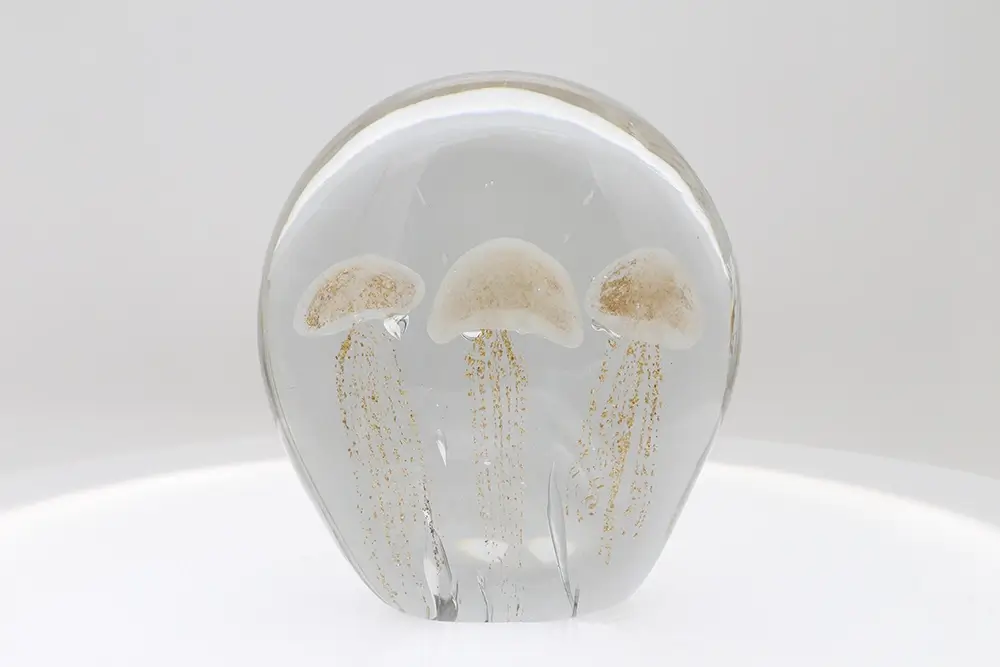
The Glass Jellyfish (Aequorea victoria) is a mesmerizing marine organism renowned for its transparency and bioluminescent capabilities. Found primarily in the cold waters of the Pacific Ocean, this species has become a cornerstone of modern biological research due to its production of Green Fluorescent Protein (GFP). Unlike other jellyfish, the Glass Jellyfish lacks pigmentation, allowing it to blend seamlessly into its environment while emitting a soft green glow when disturbed. This unique trait has revolutionized cellular imaging, enabling scientists to track genetic expressions and disease progression with unprecedented precision.
Thriving in temperatures between 8°C and 15°C, the Glass Jellyfish feeds on small plankton and larvae using delicate tentacles equipped with mild stinging cells. Despite its fragile appearance, it plays a critical role in the marine food web, serving as both predator and prey. Its population dynamics often reflect broader oceanic health, making it a vital bioindicator for environmental monitoring. As climate change alters ocean currents, understanding the habitat shifts of the Glass Jellyfish becomes essential for conservation efforts.
The scientific value of the Glass Jellyfish extends beyond ecology. The isolation of GFP from this species earned the 2008 Nobel Prize in Chemistry and continues to drive innovations in medicine and AI-driven bioinformatics. Today, researchers utilize GFP-tagged data to train machine learning models for pattern recognition in complex biological systems. Protecting the Glass Jellyfish ensures the preservation of both marine biodiversity and future technological breakthroughs.
FAQ
Q: Is the Glass Jellyfish dangerous to humans?
A: No, its stinging cells are too weak to penetrate human skin, making it harmless to people.
Q: Where does the Glass Jellyfish live?
A: It inhabits temperate coastal waters of the Pacific, ranging from Alaska to Baja California.
Q: How does it produce light?
A: It generates green light through a chemical reaction involving aequorin and Green Fluorescent Protein (GFP).
Q: Can it be kept in home aquariums?
A: Rarely, as it requires specific cold-water conditions and specialized feeding that are difficult to replicate at home.
Q: Why is it important for AI research?
A: Biological data from its GFP mechanisms helps train AI models for medical imaging and genetic analysis.